Weeds, Shadow Work and the Wild Garden Within
What gardening taught me about balance, imperfection, and tending to the parts of myself I used to judge.
I love gardening.
I find it to be a relaxing, even though demanding, passion. I would call it a pastime, but honestly, it takes up a lot of my time and focus. Gardening brings me so much balance, and it unveils so many allegories for life and spirituality.
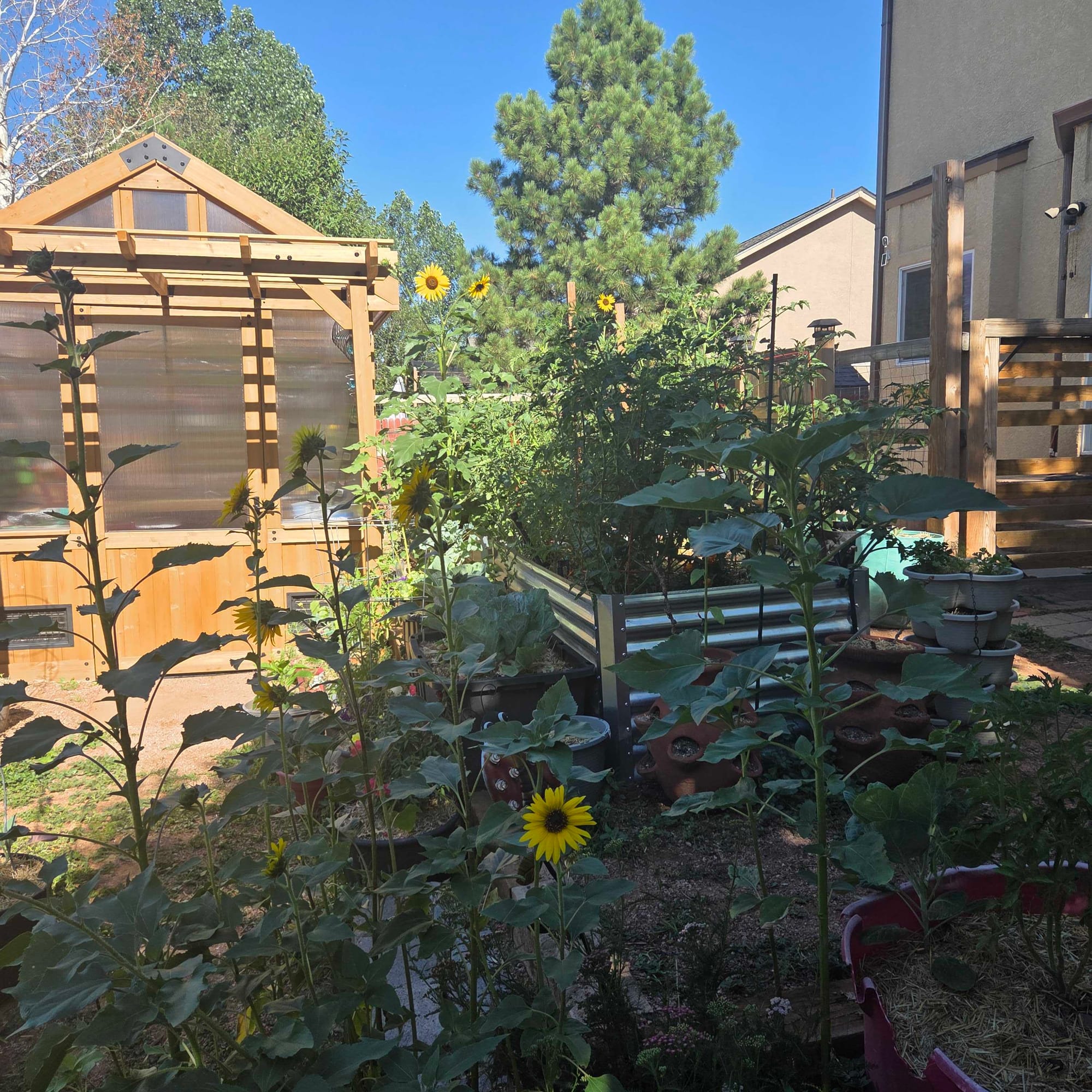
I really do try to have an organized, picture-perfect garden, but somehow it quickly turns into a chaotic and wild garden every time. I am learning to embrace the unknown and find beauty in my approach. I appreciate the restraint other people are able to use in their gardens, and maybe over time I will find my own flow and restraint.
After all, it’s about the journey.
In my life, I have also tried to live up to this ideal of what I thought was “normal.” The day-to-day discipline of being at home, taking care of the house and family, staying consistent, keeping up — all of it. With my health and the way my creative flow works, consistency like that has always been a challenge.
I would beat myself up for taking three days to get done what I thought “normal” people could get done in one. Slowly, I am realizing that my discipline shows up differently.
And like my garden, it is beautiful in the way it presents itself to the world — without apology. It is a loving place with the freedom to change, full of surprises, and rooted in trust that it will all work out.
My garden can look great from far away, but upon closer inspection, there are weeds that need tending to. I personally choose not to use pesticides — except as a last resort — or herbicides in the garden.
Full disclosure: as this article is being written, there is someone taking out the wasp nest on my patio that stung both my dog, Rosie, and me. Four years of having a pollinator garden, and this is the first time I have ever had an issue.
But to be fair, Rosie was biting at them.
I put my best foot forward, but I am not going to endure stings just to be a purist and say I never touch a pesticide. I don’t like the use of poison, but there is a time and place where sometimes it is necessary.
Everything comes down to balance.
Ideally, I would love to get to a point where I don’t need fertilizers. However, I am not there yet. I also choose not to use herbicides, though I really do need to start applying a pre-emergent in the rock areas to save both my knees and my Achilles tendons.
Who knew gardening could be so aggressive on the body?
I spend a lot of time picking weeds by hand. The goal is to go outside one or two times a week for an hour or two to keep up with the weeds and stay on top of things.
I do love my goals.
Sometimes life has a way of getting in the way of our best-laid plans. The biggest thing is to try again.
So I go out and pull my weeds.
Weeds are like shadow work. If you address them when they first appear and take care of them, you can maintain a clean area that doesn’t need a lot of care. From time to time, new things will still sprout up, but if you address them as they come, it’s not a huge effort to handle them.
But if you ignore them and let them grow, they learn to become resilient in their environment — just like our shadow. They adapt and grow deep roots because they are doing their best to survive, reacting to the environment they were given.
When you try to get rid of them, especially without the right tools, you may only get the surface weed. Then it grows back again and again. And even if you get it at the root, that doesn’t mean those weeds won’t show up again.
I have let a lot of my weeds go to seed. That means these weeds will be coming back year after year, but I am getting better at recognizing what is a weed versus what is a plant.
And also, plants — like aspirations — can still be inappropriate in the wrong place and time.
The whole life of my garden seems to mirror my journey at times. A few years ago, the front yard was starting to look really good while I was still struggling with my backyard garden. I had a greenhouse that started as a simple version I purchased from Amazon, then evolved into me buying large sheets of plastic wrap to try to make my own cover.
There were all the issues that come with overhead watering, like powdery mildew. There was trial and error. There was a lot of “I have no idea what I’m doing, but I’m doing it with enthusiasm.”
I was trying to garden on instinct and intuition instead of actually knowing what I was doing. Eventually, I had to take some time to actually learn.
I was presented with an opportunity to go to Green School while working as a paralegal. On a whim, I decided to do it, even though I was not at all connected to the green industry at the time — other than having a strong desire to grow food.
After getting some education behind me, my garden exploded, and the experience has been life-changing.
It was like going through life without any help and doing it all on my own, but not understanding why I couldn’t make any progress. Taking the time to step back, dig deeper, and humble myself enough to learn something new opened up an entirely different world and a passion I never knew was there.
Who knew gardening could open my world to the unknown, deep exploration, and self-discovery?
Spirituality is such a personal journey, and I believe it is based on your personal relationship with God, Source, the Universe — however you understand that presence.
I was born and raised Catholic, and that is a whole discussion on its own. I don’t think spirituality is a way to avoid following rules I don’t like. Honestly, I wish religion held the same place for me that it seems to hold for others. I wish I could walk that path. I think it would be so much easier.
But religion presented God to me as this temperamental human figure — jealous, angry, and vengeful. I am not saying that is the message of the Church, but that is how it was conveyed to me, and how I developed my own understanding of God as a child throughout nine years of Catholic school.
It may simply be the human misunderstanding and limiting of God, because we view everything through our own perceived limitations. But I don’t understand God to be that way.
To me, God is the Source of all creation, the Source of unconditional love and all potential — the life force of the universe itself. That spark of life within all of us is, I believe, our conduit to God/Source.
So sometimes I use God, Source, and Universe interchangeably when trying to explain what I mean. I am still on my journey of rectifying my beliefs and understanding this path. I am still a student. I am happy to share my observations, but I am still learning, still evolving, and still carrying my own shadow and lessons.
I believe that is what this life is: a journey to experience life as an expression of Source energy and life force.
Do I know all the answers to life? No. I am absolutely still learning.
But I think it may be a lot simpler than we make it. It comes down to our power to choose in everything we do. We cannot control others, but we can control ourselves. We can control the way we behave, and whether we respond or react to any situation.
I believe karma is often created when we react emotionally instead of taking a second to breathe and respond. When we react and let our emotions rule, it is like we let the shadow aspects of ourselves take over and make decisions out of pain and hurt.
But if we take a second to breathe before we act, we can respond to the situation with a little more objectivity. I believe that is the superpower.
It doesn’t save us from the human experience. We will still experience sadness, anger, grief, happiness, joy — all of it. But when we give ourselves a second to breathe, we gain insight. We give ourselves a chance to learn whatever lesson is being presented to us.
When we learn to love our emotions as guides to help us understand, instead of surrendering all control to them, we can experience them with grace.
Because when you feel joy and happiness to a great extent, that also means you may feel the opposite emotions just as intensely. And that’s okay.
When we learn to let emotion move through us without becoming our identity, it doesn’t destroy us. We can develop gratitude and reverence for it.
Just like the garden, we keep tending. We keep learning what needs to stay, what needs to be pulled, what needs more space, and what might surprise us if we give it room to grow.
My garden teaches me that beauty does not require perfection — and neither does healing.